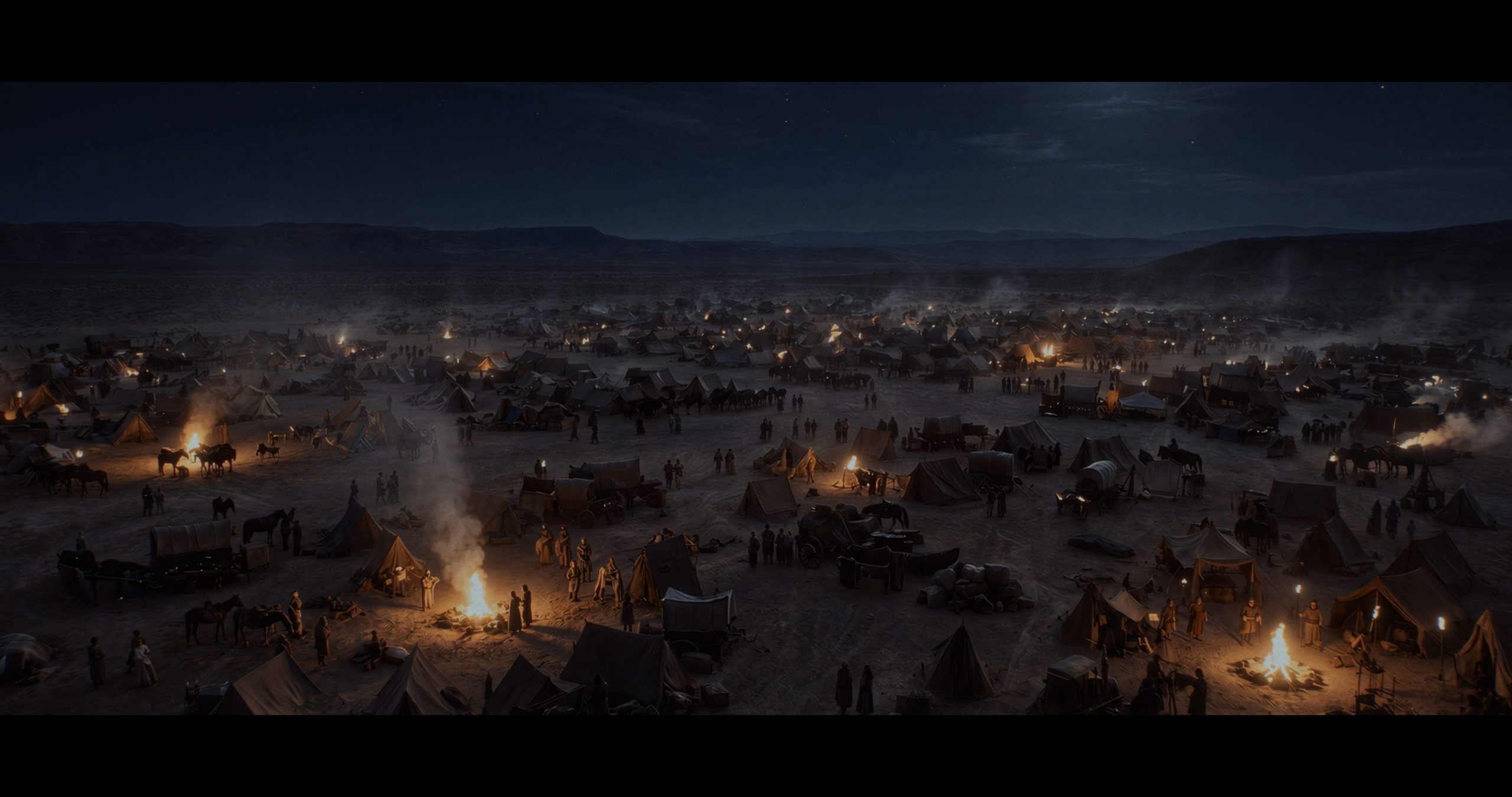
How many times have you seen a film in the name of a biblical film? Hollywood has a long tradition of distorting sacred scripture and adding love triangles, changing characters, and painting a religious veneer over stories and entertainment that have no religious context.
“The Flood: End of Mankind” is not that movie.
The movie treats the Bible’s message with sincerity and respect. Not loosely. Not “inspired by.” Seriously. And when you compare what this film has shown you on screen to what Genesis actually states, you get a very different impression. It honors the story of Noah. Let me explain everything I felt after watching the film.
Bottom line: It stays true to the Word and is an incredible analogy and metaphor to the story of Noah.
Overview
Location Viewed: Atlanta Screening (June 9, 2026)
Rating: 8.3/10
What the Bible Says About Noah?
Before discussing the film, let us go back to the source. The story of Noah appears in Genesis chapters 6 through 9. It is one of the most detailed and dramatic stories in all of Scripture. The story is about humanity’s complete moral failure, God’s grief, one man’s obedience, and God’s mercy in the midst of judgment.
Genesis 6:5 says: “The Lord saw that the wickedness of man was great in the earth, and that every intention of the thoughts of his heart was only evil continually.”
All humanity was in darkness. God’s response was not anger for its own sake. It was the grief of a Creator watching His creation destroy itself.
Into that darkness, one man stood apart. In Genesis 6:9, it says that Noah was a “righteous man, blameless in his generation” who “walked with God. He was not perfect. But he was faithful. And that faithfulness made all of the difference.
This is the foundation of “The Flood: End of Mankind’’
Faithful Portrayal of Noah
The Flood: End of Mankind refuses to make Noah a superhero. The Bible does not portray him as one, either. He’s a regular guy who faces an extraordinary task. The weight of that assignment is visible in every scene. Kevin Sorbo’s portrayal captures this beautifully.
His acting was so good that producers described it as “Oscar-caliber,”. And audiences walking out of early screenings in New York City used words like “stunned” and “powerful. You will feel that too while watching the film. I know the audience in Atlanta were truly mesmerized and they actually did an altar call at the end to receive Christ.
The movie starts 3 days before the flood. That specific framing is significant. It puts the audience in the middle of the tension of the final warning. The Bible describes Noah as a “preacher of righteousness” in 2 Peter 2:5. This movie will give you an idea of what this was like. A man standing before people who have already made up their minds, offering them a door they refuse to walk through. This is heartbreaking to watch. It’s also literally true to the Bible.
The Ark was Built Exactly as God Commanded
Here is where the other Noah film from Russell Crowe fall apart. They show a boat. A big boat. That’s all they say. However, the Bible is quite specific about the Ark, its size, its construction, what it looked like — and there’s a reason for that. They are part of the story’s truth.
Genesis 6:14-16 gives precise instructions: the Ark was to be made of gopher wood, coated inside and out with pitch. It was to have rooms, a roof, a door on the side, and three decks.
The Ark carries the weight of its purpose. Costume designers Susan F. Chey and Alena Trutsko, along with the full production team, worked to ensure that every visual detail of the ancient world surrounding the Ark felt grounded. The audience remarked that the film looked like a $100 million film.
The Wickedness of the World Shown Without Flinching
In the Film The book of Genesis does not attempt to make the world look prettier before the Flood.
A land of bloodshed, dishonesty, and absolute rottenness. Genesis 6:11 says that the earth was “corrupt in God’s sight and filled with violence”. This was not background detail. It was the entire reason for what was coming.
This side of the story is not shown in many faith-based films. They make things easy. They don’t want to reveal to the audience the whole picture of human darkness. The Flood: End of Mankind doesn’t make the mistake.
The film is honest about the world Noah lived in. It does not glorify the darkness — but it does not hide it either. And that honesty is what makes Noah’s faithfulness meaningful. You cannot understand why one righteous man mattered so much unless you understand how completely alone he was in his righteousness.
The Emotion the Bible Captures and So Does This Film
God’s response to human wickedness is not described first as anger. It is described as grief.
This is the best part I believe of the film. It shows the raw wickedness of the days of Noah. This is a visual and stunning feast. Even to my daughter who was also stunned.
Genesis 6:6 says: “And the Lord regretted that he had made man on the earth, and it grieved him to his heart.” It is one of the most spectacular statements in the Bible. The Creator of the universe, grieving. And “The Flood: End of Mankind” carries that emotion.
It’s a movie about a loving God who warned us in every way possible of what would happen if we made the wrong decisions. It asks the audience to sit with the weight of what they are seeing rather than handing them an easy emotional resolution. That is exactly the kind of storytelling the biblical film invites.
Understand the Symbolism of the Ark
The Ark is one of the most potent symbols in the Bible. And “The Flood: End of Mankind” brings that meaning into the story.
The Ark had one door. Genesis 6:16 specifies it. One door. And Genesis 7:16 tells us that after Noah and his family entered, “the Lord shut him in.” God himself closed the door. That detail is staggering in its implication.
The filmmakers connected the Ark with Christ. While watching the film, people will realize the Ark was the only way to escape death during the Flood, Christ is presented in the Bible as the only way to salvation today.
Jesus said in John 10:9, “I am the door. If anyone enters through me, he will be saved.” The connection between the Ark and Christ is central to the message of the film. Many pastors have praised how the film brings these biblical themes to life. The movie allows the message of Scripture to speak for itself. It actually encourages viewers to think deeply about its meaning.
The Great Flood Captured Beautifully
The Flood described in Genesis 7 is one of the most dramatic events in the Bible. God opened the windows of heaven. The rain fell for 40 days and 40 nights.
The water grew until it covered the mountains on earth. For many years, filmmakers have struggled to show the true scale of this moment until now. The Flood: End of Mankind attempts to capture the power and seriousness of the biblical account.
Early viewers are considering the end of “The Flood: End of Mankind” (when the rains finally start) as one of the greatest cinematic endings ever made.
One pastor who attended the premiere compared it directly to The Lord of the Rings. Multiple audience members have called it history-making. The CGI and AI-driven visual effects used in the film bring the apocalyptic scale of the flood to life properly.
The sound design by Nick Carigan and Zsolt Magyar is a huge part of why this works. The slow build of distant thunder. The growing darkness. And then the roar — the full, overwhelming, chest-filling roar of water that does not stop. It is the kind of experience that makes the biblical account feel not like ancient history, but like something urgently, terrifyingly real.
The Heart of Both the Bible and The Film: Noah’s Faith
Hebrews 11:7 summarizes Noah’s story in one sentence:
“By faith Noah, being warned by God concerning events as yet unseen, in reverent fear constructed an ark for the saving of his household.
By this he condemned the world and became an heir of the righteousness that comes by faith.”
By Faith
That is the center of everything. Noah didn’t see the flood coming.
He built an enormous structure in the middle of dry land because God told him to. He trusted that God’s word was enough.
This is beautifully shown in the film. Kevin Sorbo does not play Noah as a man with all the answers. He plays him as a man who has chosen to trust the one who does. Real faith is not the absence of fear or doubt. It is the decision to obey anyway.
The other actors are equally realistic. Sam Sorbo, Aaron Groben, J. Fernando Krymis, and Danny Fehsenfeld did a fantastic job. They’re true portraits of real people at the most apocalyptic moment in human history.
Why This Film Matters Right Now?
The biblical story of Noah ends with a rainbow — God’s covenant promise that He would never again destroy the earth by flood.
Genesis 9:13: “I have set my bow in the cloud, and it shall be a sign of the covenant between me and the earth.” It is a promise of mercy wrapped inside a moment of devastating judgment.
But the New Testament does not let the story rest there. Jesus himself references Noah in Matthew 24:37-39: “As were the days of Noah, so will be the coming of the Son of Man. For as in those days before the flood they were eating and drinking, marrying and giving in marriage, until the day when Noah entered the ark, and they were unaware until the flood came and swept them all away, so will be the coming of the Son of Man.”
Jesus was not just referencing history. He was issuing a warning. The days of Noah are a mirror — and the film holds that mirror up clearly and without apology.
The trailer for “The Flood: End of Mankind” has already clocked over 530,000 views in just a short time. It stunned audiences at SXSW and in New York City. The film also premiered at CinemaCon and at the NRB — the largest faith-based convention in the United States. Advanced screenings begin across the country in June and July 2026, building toward a nationwide theatrical release on October 1, 2026.
The world is paying attention. And perhaps that is exactly the point.
A Film That Earns Its Place Beside Scripture
Does The Flood: End of Mankind get everything right? No film could. The biblical account holds depths that no 94 minute movie can fully plumb. But does it honor the Scripture it is drawn from?
I would say, completely and wholeheartedly, yes.
Viewers are already comparing it to the gold standard of biblical cinema. As I mentioned earlier, it looks like a $60 million film. And Kevin Sorbo’s performance as Noah is being called the finest of his career.
This is a film that makes you want to open your Bible again. It makes the ancient story feel urgent, alive, and deeply personal. It reminds you that the God who spoke to Noah is still speaking. That the door is still open. And that the rain is coming. October 1, 2026.
Be in that theater with your loved ones.
Bring faith in God back again to a world that needs to get right with God.
More information: https://www.imdb.com/title/tt9135246/?ref_=ext_shr_lnk
About the Author