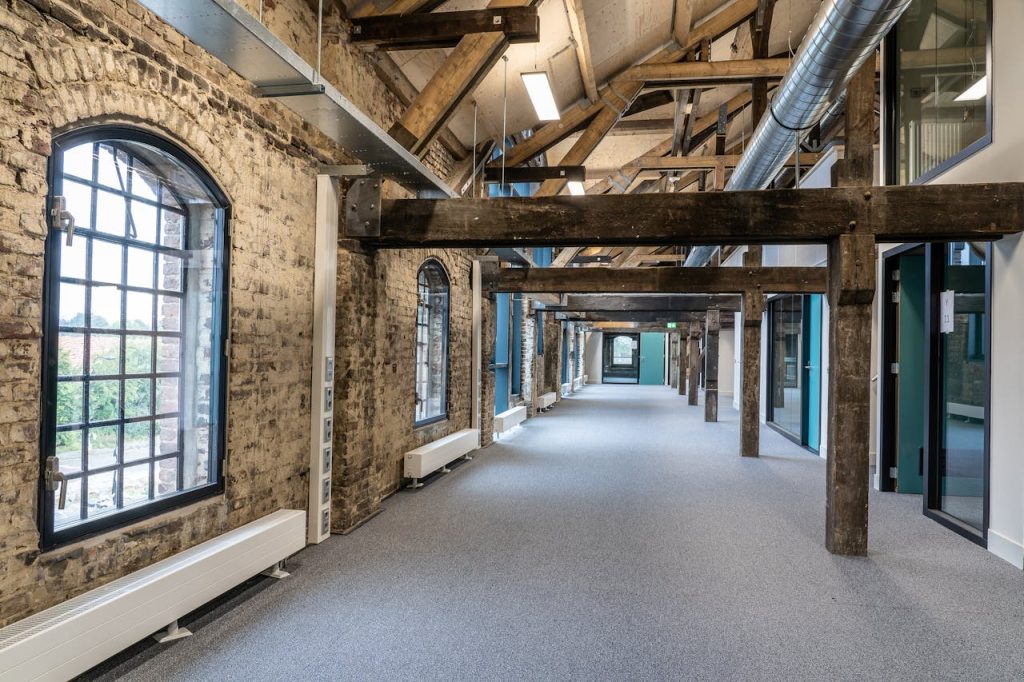
Renovation tends to surface when something stops working. A lease feels heavy. Energy bills rise without explanation. Employees show up less often, or customers leave sooner than expected.
Rami Tawasha approaches renovation as a response to these signals, not as a design trend. Early in the conversation, he frames it simply: “Most businesses already have the space they need. The real question is whether that space is helping or holding them back.”
That perspective matters right now. U.S. construction spending recently exceeded $2.17 trillion, with roughly $737 billion tied to nonresidential projects. Growth, however, has slowed to low single digits. For many organizations, that shift redirects attention inward. Instead of expanding, they focus on making existing spaces perform better.
Renovation as a Financial and Operational Choice
Tawasha treats renovation as a business decision before it becomes a design exercise. When nonresidential construction growth hovers around two to three percent, leaders look for investments that carry less risk and faster returns. Renovation fits that profile.
A closer look shows why. Upgrading an existing building avoids land costs, shortens timelines, and allows phased work that keeps operations running. This might seem basic, but it changes how projects get approved. Renovation becomes a way to stabilize cash flow while still improving performance.
Tawasha often emphasizes restraint. “A renovation does not have to be loud to be effective,” he says. “If the space works better, people notice. If it does not, no amount of polish will save it.”
Offices That Justify Showing Up
Office renovation sits at the center of Tawasha’s thinking, largely because behavior has shifted faster than buildings have. Office access data shows that average weekly occupancy remains below 50 percent, while peak days climb above 60 percent. People still come in, but selectively.
Research links workplace quality to engagement, and engagement ties directly to retention. Nearly 97 percent of highly engaged employees say they plan to stay with their employer, compared with just 53 percent among disengaged workers. Space does not create culture on its own, but it can support or undermine it.
Tawasha views renovation to earn the commute. That means fewer assumptions about how people should work and more support for how they do.
Key renovation priorities tend to be practical:
- Clear separation between quiet focus areas and collaborative zones
- More small rooms instead of oversized conference spaces
- Better acoustics and lighting that reduce fatigue
Customer Spaces and the Experience Gap
Customer-facing environments operate under a different set of pressures. Experience plays an outsized role in purchasing decisions. About 73 percent of customers say experience influences what they buy, and 65 percent of U.S. consumers say it matters more than advertising.
Retail sales in the U.S. continue to reach into the trillions, with steady year-over-year growth. Physical spaces still compete for real dollars. Renovation helps those spaces close the experience gap created by fast, intuitive online interactions.
Rami Tawasha approaches these projects with a simple question: where does friction show up? Confusing layouts, poor lighting, and slow service flow all push customers out quietly. Renovation removes those barriers.
On the other hand, when wayfinding improves and spaces feel intentional, customers tend to stay longer and return more frequently. The return shows up in dwell time, repeat visits, and reviews, not just aesthetics.
Health, Air Quality, and How People Think
One of Tawasha’s strongest positions centers on indoor air quality. It rarely headlines renovation discussions, yet research shows clear links to performance. Studies have connected higher carbon dioxide levels with slowdowns of 1 to 2 percent in response time and noticeable drops in cognitive throughput.
This is not abstract. People feel it before they can explain it. “When air quality improves, complaints usually stop before praise starts,” Tawasha notes. “That silence tells you the upgrade worked.”
Health-focused standards reinforce the point. Workplaces aligned with WELL principles show jumps in satisfaction from the low forties to around 70 percent, alongside measurable gains in perceived productivity. Renovation that improves ventilation, filtration, and thermal comfort supports clearer thinking, which supports better work.
Energy Waste and Margin Protection
Energy efficiency remains one of the most quantifiable renovation benefits. Commercial buildings account for a large share of U.S. energy use.
Renovation captures those losses. ENERGY STAR–certified office buildings use about 35 percent less energy, generate fewer emissions, and cost roughly $0.54 less per square foot to operate. Retro-commissioning alone often delivers around 15 percent energy savings with payback measured in months, not years.
Tawasha frames these projects as margin protection rather than sustainability statements. Lower operating costs stabilize budgets and reduce exposure to future price swings. That stability becomes increasingly valuable in uncertain markets.
Safety, Risk, and Continuity
Some renovation outcomes only appear when something goes wrong. Workplace injuries cost employers more than $1 billion per week in direct workers’ compensation expenses. National data continues to show thousands of fatal work injuries each year.
Renovation reduces these risks quietly. Improved lighting, clearer circulation paths, and better ergonomics prevent incidents that disrupt operations. In industrial and healthcare settings, these changes protect both people and uptime.
Tawasha sees safety-driven renovations as some of the easiest to justify internally. When upgrades clearly reduce harm, the business case tends to speak for itself.
Measuring Whether a Space Truly Thrives
Tawasha resists vague definitions of success. Thriving spaces leave evidence. Energy use drops. Maintenance calls decline. Turnover stabilizes. Customer behavior shifts.
Tracking these outcomes requires baselines and follow-through, but it turns renovation into a repeatable system rather than a one-off project. Small improvements across several metrics often outweigh a single visible upgrade.
Final Thoughts
Rami Tawasha’s vision treats renovation as quiet infrastructure for business health. The numbers support it. Lower energy waste, stronger retention signals, better customer experiences, and safer operations all point to the same conclusion. Spaces that help businesses thrive rarely draw attention to themselves. They simply make work easier, decisions clearer, and outcomes more predictable.